Canadian Slavery and Canada’s Role in Transatlantic Slavery
Book NowAtlantic Black Box presents the Atlantic World Connections series features scholars, memory keepers, and community historians doing groundbreaking work to surface suppressed stories of oppression and resistance in the Dawnland…. which includes the area known as the Canadian Maritimes.
On Wednesday, March 18, learn from Dr. Charmaine A. Nelson, Provost Professor of Art History at UMass Amherst and founder of the Slavery North initiative, as she shares her research on the history of enslavement in Canada and the northern Atlantic.
Date/Time: Wednesday, March 18, 2026 at 6:00 pm ET
Speaker: Charmaine A. Nelson
Lecture: Canadian Slavery and Canada’s Role in the Transatlantic Slave Trade
Location: Online, register here
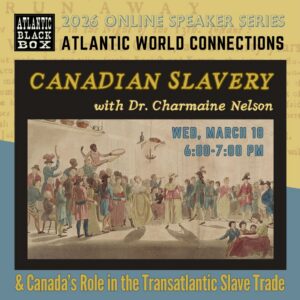
This presentation situates Canadian slavery within the broader 400-year history of the transatlantic system of enslavement, challenging persistent myths of Canada’s racial innocence. Drawing on art historical analysis, archival research, and visual culture, Dr. Charmaine A. Nelson of UMass Amherst’s History of Art & Architecture Department and W.E.B. DuBois Department of Afro-American Studies examines the networks of power, violence, resistance, and representation that shaped slavery across the Atlantic world—including in regions of the American North and Canada that are often imagined as peripheral to the system.
Through close attention to primary sources—from fugitive slave advertisements and colonial records to historical images and material culture—Nelson demonstrates how visual and textual archives reveal the lived realities of enslaved people while exposing the ideological frameworks that sustained slavery and racial hierarchy. The talk also introduces the interdisciplinary methods that underpin Transatlantic Slavery Studies, highlighting how scholars work across archives, images, and cultural artifacts to reconstruct histories long minimized or obscured in national narratives.
By bringing Canadian slavery into dialogue with the broader Atlantic world, this presentation invites audiences to reconsider the geography of slavery in North America and to confront how deeply the institution shaped societies often assumed to stand outside it.
Book Now