Welcome 2026: The Arts, Advancements, and Athletics We’ll be Eyeing in 2026
1.World Baseball Classic Kicks off in March
If you’re like us, when the Blue Jays lost game seven to the L.A. Dodgers in the 2025 World Series, we had an immediate case of baseball withdrawal. But never fear, because baseball will soon come roaring back to the world stage when the World Baseball Classic (WBC) kicks off on March 5th, 2026. This international tournament brings together the finest men’s teams who will do battle in four pools spread out across three sites: Japan (Tokyo), Puerto Rico (San Juan), and the USA (Houston and Miami). The pool games will take place between March 5th – 11th, 2026 with the championship being played on March 17th, 2026. So, who are we cheering for? Canada of course! It appears that the mighty Freddie Freeman of the L.A. Dodgers (whose mom and dad were born in Peterborough and Windsor, Ontario respectively) and Josh Naylor of the Seattle Mariners (from Burlington, Ontario) – whose fearsome bats we recently experienced against the Jays in the 2025 playoffs – are suiting up for Canada. But even still, it won’t be easy for our men to make it out of Pool A which includes Colombia, Cuba, Panama, and Puerto Rico! We also love us some D.R. dominance and look forward to seeing greats like Juan Soto, Julio Rodríguez, and our beloved Blue Jay Vladimir (Vladdy) Guerrero Jr. take to the field together.

Team Canada’s Freddie Freeman
2. Slavery North Conference Marks the 250th Anniversary of the Declaration of Independence
If you’re like us, you were never taught anything about the Revolutionary War. Why is this important? Well, because the war was fought between rebelling Americans and the British, to whom those in the northern colonies (which would later become Canada) remained loyal. Hence the term Loyalist. This nation-defining war took place between 1775 and 1783 and 2026 marks the 250th anniversary of the United States. While many will be celebrating, others are taking the anniversary as an opportunity to interrogate the historical context of this imperial conflict and its impact on people and communities that are almost never discussed, like enslaved people of African descent. Like all conflicts, the Revolutionary War brought disruption, violence, and uncertainty. However, because it unfolded at a moment when Transatlantic Slavery was yet to be abolished, for the enslaved, the war also brought the large-scale upheaval of forced inland and maritime migration which presented opportunities for escape and emancipation. Leave it to Prof. Charmaine A. Nelson, our fearless leader, to use her cutting-edge humanities and fine arts institute, Slavery North, to host a conference that invites papers that rethink the cultures, events, and experiences of the war across the porous borders of British North America. Why is this conference a game-changer? Well, most scholars of early America have centered studies on the political motivations and military manoeuvres that influenced the white rebels, the grassroots impact of sedition, and the interpretation of the constitutional debates. Meanwhile, most scholarship on the Canadian side of the border has been regionally and thematically biased towards a celebratory focus on White Loyalists in the Maritimes. In contrast, very little scholarship – Canadian or American – has been devoted to recuperating and understanding the experiences of the enslaved across regions, origins, identities, climates, geographies, and circumstances. Nor has sufficient attention been paid to the turmoil that ensued when White Loyalist enslavers, those they enslaved, and newly freed Black Loyalists were all simultaneously evacuated into northern (Canadian) territories which had already been shaped by Transatlantic Slavery. Slavery North has taken up the challenge of hosting its first academic conference – Rebellion, Resistance, and Refuge: Slavery and Border-Crossing During the American Revolution – on these complex histories. While the call for abstracts ends on December 19th, 2025, the conference will take place at the University of Massachusetts Amherst from July 9th to 12th, 2026. All are welcome. Admission is free.
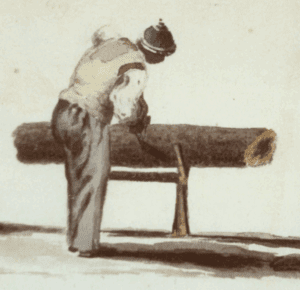
Captain William Booth, “Image of Unknown African Nova Scotian” (1788)
3. Bad Bunny Takes to the Super Bowl LX Stage
No offence to the NFL, but it is estimated that more people tune into the Super Bowl to watch the Halftime Show than for the game itself. This was certainly the case with Kendrick Lamar’s record setting performance which attracted 133.5 million viewers during Super Bowl LIX in 2025. Well, 2026 may be another record-breaking year when the Puerto Rican reggaeton megastar Bad Bunny (Benito Antonio Martínez Ocasio) takes the stage on Sunday, February 8th, 2026, in Santa Clara, California. If you do not know who Bad Bunny is, you may have been living under a rock for the last nine years during which he became a global streaming phenom, breaking records with Spanish-language albums like Un Verano Sin Ti, winning three Grammys and twelve Latin Grammys, and putting up crazy numbers for his tours. Powerfully, his most recent tour in Puerto Rico was an economic and cultural powerhouse and a show of pride generating hundreds of millions of dollars in revenue and boosting tourism to the Caribbean island. The show featured traditional Puerto Rican rhythms like Bomba and Salsa and presented lesser-known local artists. Indeed, as The Guardian’s Adrian Horton reported, his Puerto Rican residency is a rare example of “fame used for good”.
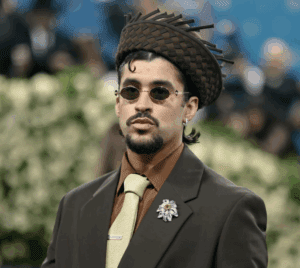
Bad Bunny
4. Black Maple Magazine Publishes the First English-Language Children’s Book about Canadian Slavery
Before our fearless leader, Prof. Charmaine A. Nelson, launched Black Maple Magazine, she had long published academic books on Transatlantic Slavery, building an international reputation as a leading scholar in the study of Canada, Jamaica, and the USA. But in 2026, she boldly enters the realm of children’s books. As Charmaine explains, “The lack of scholarship and publications on Canadian Slavery for academic and lay public audiences also extends to children’s literature.” To be clear, there is no shortage of children’s books on Transatlantic Slavery, but most books focus – like the academic literature – on the US South and the Caribbean, centring tropical planation slavery and places where the enslaved outnumbered their white enslavers.
There is also no shortage of books on the Underground Railroad which represent Canada as a haven to which enslaved African Americans fled for their freedom between 1834 and 1865. While this history is true and important, white Canada clings to it because it has and can be used to bury the two-hundred-year history (1600s to 1834) of British and French participation in Transatlantic Slavery in Canada. In contrast, what is almost entirely absent are books that narrate the histories of slavery in northern, temperate climate regions like Canada and the US North.
Why is this important? Climate had a profound impact on how white enslavers practiced slavery. As such, it dramatically changed the experiences of enslaved black people who were commonly forced to live in the same residences as their enslavers, to perform both domestic and outdoor labour, and to live in regions in which they suffered stark isolation from their African and African-American (continental) cultures. Hyper-surveillance, cultural isolation, and an inability to build black community characterized their experiences and amplified their suffering. The realities of enslaved people in these regions and their experiences of everything from health care to nutrition, travel, maternity, punishment, resistance, intimacy, and family formation have yet to be fully explored in adult or children’s literature.
It is into this abyss that Charmaine has published Joe the Pressman: The Incredible True Story of an Enslaved African Boy who Became a Heroic Freedom Fighter, the first English-language children’s book on Canadian Slavery. As the book’s lengthy title (that approximates eighteenth-century titular practices) reveals, Joe was born in Africa and enslaved and sent to North America where he was eventually sold to the co-founders of the Quebec Gazette newspaper, William Brown and Thomas Gilmore. Joe’s story is extraordinarily unique for several reasons. First, because slave ships did not typically travel from West Africa to Canada, most enslaved black people were African Canadian, African American, and African Caribbean, and African-born people became a minority within an enslaved black minority population. While most enslaved people were prohibited from attaining literacy, Joe’s enslavers forced him to become fluently bilingual in English and French to facilitate his forced labour in their printing shop.
That we know about Joe at all is due to his legendary resistance. Joe ran away and forced William Brown to document his existence when he published fugitive slave advertisements for Joe’s return. Remarkably, today we can recuperate six sets of advertisements for Joe’s escapes across nine years (1777-1786), making him the most outwardly resistant enslaved person known in Canadian history. Charmaine’s book not only centres Canadian Slavery and the uniqueness of black enslaved experiences through Joe’s forced transatlantic journeys, labour, and resistance, it disrupts the stubborn white Canadian desire to offer the Underground Railroad as the only story of Canadian involvement in slavery.

Cover Image for “Joe the Pressman”
5. Red Light Therapy
One of the most persistent myths in the aesthetic industry is that all light-based therapies are no-go territory for black people. But all light technologies are not the same. While some heat-intensive lasers can indeed trigger post-inflammatory hyperpigmentation (PIH) in melanin-rich skin, Red Light Therapy (RLT) is a different breed of brilliance. RLT first got liftoff (literally) when astronauts used it to grow plants in space in 1995. RLT is a non-invasive treatment that uses low-level wavelengths of red and near-infrared light to penetrate skin and promote cellular function (mitochondria) and tissue repair. According to Kaitlin Leduc, the therapy entails having a continuous red light placed on a targeted area of skin at a light wavelength between 630 and 700 nanometres. the light boosts cellular energy production, reducing inflammation, and promoting collagen synthesis. Unlike UV rays, RLT is non-ionizing and does not interact with melanin to cause darkening. So, what’s it good for? Well, RLT has been shown to have positive impacts for combating androgenic alopecia (inherited pattern baldness) by increasing blood flow to the scalp, providing follicles with the oxygen and nutrients needed to increase hair thickness and density. For those prone to keloids or chronic sensitivity, RLT may accelerate wound healing and calm inflammation without the irritation associated with harsh chemicals. Beyond skin and haircare, emerging research suggests that RLT may enhance mood and improve cognitive function, offering a new tool for mental health maintenance. Now it’s easier than ever to forgo the medical spa and bring this technology home with hats, face masks, and wraps designed for different parts of the body that deliver benefits in the comfort of your home.

Red Light Therapy Mask
6. Monuments Exhibition at MOCA, Los Angeles
The Museum of Contemporary Art, Los Angeles (MOCA) and The Brick (a non-profit visual art space) have teamed up for an important exhibition which takes up where the movement to remove and decommission Confederate, Civil War monuments left off. The Monuments exhibition (October 23rd, 2025 – May 3rd, 2026) reflects on the histories that led to the erection of the monuments as well as the movement to reconsider, remove, and reinscribe them and the cultural and political landscapes in which they were erected (and that they marked and shaped), with new meanings. The curatorial team which included Hamza Walker (Director of The Brick), Bennett Simpson (Senior Curator at MOCA), and Kara Walker (artist) considered the ways public monuments have shaped national and racial identity, historical memory, and the current political terrain. The show was inspired in part by the decommissioning of some two hundred monuments that came in the wake of the racially-motivated mass shooting at the Mother Emanuel AME Church in Charleston, South Carolina (2015), Bree Newsome’s courageous removal of the Confederate flag from the South Carolina statehouse (2015), and the “Unite the Right” white nationalist rally in Charlottesville, Virginia (2017). To understand the profound African American and Black Diasporic suffering around the flag, one must acknowledge that it was created by a group of white politicians who represented states that sought to separate themselves (secede from the nation) and fashion a new country in order to preserve and expand Transatlantic Slavery into new territories. Monuments is a call for a rigorous interrogation of the distant and recent racial and racist past and for critical engagement with the systematic project of erasing, sanitizing or elevating the histories of white supremacy that produced such monuments in the first place.
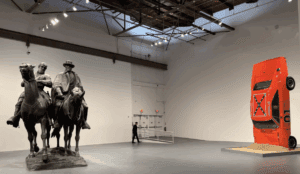
Installation photo from the “Monuments” exhibition
7. FIFA Takes North America by Storm
With the World Baseball Classic in March and FIFA in June and July, 2026 is shaping up to be a colossal sporting year! What’s more, both international tournaments include North American venues. Even better, for the first time ever, FIFA is coming to Canada! The venues include Atlanta, Boston, Guadalajara, Kansas, Houston, Mexico City, Miami, Monterrey, New York/New Jersey, Philadelphia, Seattle, Toronto, and Vancouver. So, who do we cheer for? Well, our Canadian men of course, led by left-back Alphonso Davies and striker Jonathan David. We are of course hoping for better results than 2022 when our men did not advance from their group. Our men are in Group B and will have to get past Switzerland, Qatar and an undisclosed European team to continue. Portugal’s Cristiano Ronaldo would dearly love to add World Cup gold to his collection of accolades before he retires. But also watch for the always disciplined and clinical German squad who will be ready to redeem themselves after a disappointing 3rd place finish in Group E in 2022. Of course, we always root for African teams like Ghana and Senegal, and Caribbean ones like Curaçao, Panama, and beloved Haiti. But never count out the Verde-Amarela Brazilian squad and watch out for Kylian Mbappé and the French team who narrowly missed out by losing to Argentina and taking home silver in 2022.
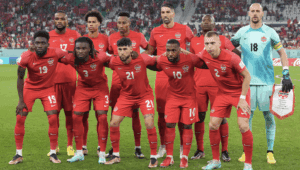
Canadian Men’s Soccer Team
8. Black Maple Magazine Launches Merch
From the start, Black Maple Magazine has supported and promoted black-owned businesses like Buy Black or Entrepreneur Tools through our empowering Resources section, or our spotlights on individual businesses like the McBride Sister Black Girl Magic Riesling or Taliah Waajid – Curly Curl Cream. So, it should come as no surprise that we’re branching out this year to offer our own fierce line of merch that’ll make you want to flex in our iconic green, red, and gold Maple Leaf logo that stands for Black Excellence in all its possibilities. In 2026, we’re bringing you the pieces you didn’t know you needed, until now!

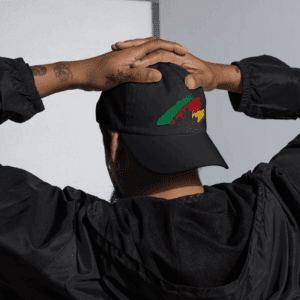
Celebrate Black Canada with Black Maple T-Shirts and Baseball Hats