Top 20 Christmas Film and TV Show Countdown
As Canadians we know that Christmastime is the season to gather together to snowshoe, skate, ski, curl, and sled (wink, wink). It’s also time to cook, eat, nap, and repeat, much of it in front of the TV. So we’re here to help with our must-watch list of the top 20 Christmas films and TV shows of this Merry Season. Enjoy!
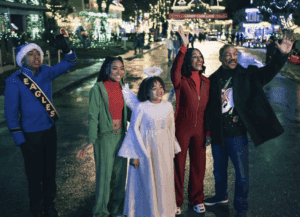
20. Candy Cane Lane (2023), Amazon Prime
As we saw in Netflix’s recent biographical documentary Being Eddie (2025), Eddie Murphy can do, and has done, it all! All includes action and comedy movies, rom-coms, dramas, musicals, and stand-up comedy. But in Candy Cane Lane (2023) Murphy also demonstrates his ability to deliver a Christmas movie worthy of dedicated family viewing.
Importantly, the plot follows the two-parent, upper-middle class, black American suburban family, the Carvers, headed by Chris (Eddie Murphy) and Carol (Tracee Ellis Ross) who have two teenagers – Joy (Genneya Walton) and Nick (Thaddeus J. Nixon of Reasonable Doubt [2022- ]) – and a younger daughter, Holly (Madison Thomas). When we first meet the Carvers, it is Christmastime, but a damper is placed on their typical upbeat festive energy by several converging problems which form intersecting plots.
You see, Chris tries to manage the stress of having just been laid off at work, while Carol balances the demands of going up for a promotion. Meanwhile, Joy has not found the courage to tell her folks that she does not want to go to USC and Nick, the talented musician and tuba player, is hiding the fact that he is failing math class. To take his mind off the loss of income and the potentially debilitating loss of his livelihood, when a local television show – complete with hilariously mismatched TV personalities, the black female Kit (Danielle Pinnock) and the white male Emerson (Timonthy Simons) – announces that the winner of the annual house decoration contest will now take home $100,000.00 USD, Chris has a new fixation. But the formerly “friendly” competition with his white neighbours Bruce (Ken Marino) and Shelly (Anjelah Johnson-Reyes) soon gets out of hand as Kit takes Holly on a trip to find the best decorations only to stumble upon a very oddly placed (under a highway overpass) Christmas store called Kringles.
But Kringles is not just any Christmas store. Unbeknownst to Chris, it is operated by a “fallen” elf called Pepper (Jilliam Bell) who sells a diabolical decoration package – based on the Twelve Days of Christmas – which entraps unsuspecting shoppers like Chris into a ritual of impossible activities that once failed, reduces them (quite literally) to miniature, ornamental Christmas figurines whom she traps in a seasonal Christmas display in the store. Chris only discovers this after buying the decorations on a subsequent trip to the store when the figurines including Pip (Nick Offerman), Lamplighter Gary (Chris Redd), and Cordelia (Robin Thede), reveal themselves to Chris and Holly and solicit their help to escape Pepper’s evil grasp.
The film operates as a family-friendly holiday caper with these several intersecting plots providing rich terrain for comedic misdirection, miscommunication, and misunderstanding. While the stellar cast of the film delivers solid, but not necessarily pathbreaking performances, the scenes during the holiday house decorating competition and the animations sequences with the miniaturized Christmas figurines are aesthetically beautiful and innovative. In the end, Candy Cane Lane is a safe but enjoyable piece of holiday programming that will bring fun and laughs for the whole family.
19. Frosty the Snowman (1969)
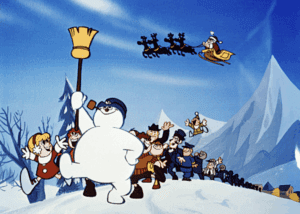
For the astute viewer, even seemingly simple children’s holiday specials can impart layers of socio-political subtext. Directed by Jules Bass and Arthur Rankin Jr., the holiday cartoon Frosty the Snowman (1969) delivers a whimsical children’s tale of magic and wonder shot through with life lessons about friendship, loss, and death.
The plot is deceptively simple, beginning with a group of children who build a snowman that miraculously comes to life because of (as the song goes) a magical “old silk hat they found”. Frosty’s life and livingness is magical not just for the children who create him and witness it, but for him also. Interestingly, his size and voice connote male adulthood, but in his wonderment at being alive and experiencing consciousness the film captures his precious innocence and wonder as he marvels at the act of living. This wonder renders him remarkably childlike as in the moment when he recounts that he can make words, move, juggle, sweep, and count to ten, the last a feat one that he still has to master. But as Frosty soon begins to sweat at the increasing temperatures, he confides in the children that warm temperatures threaten his very existence, or, as he puts it, “I start to melt…(and) get all wishy washy.”
But who are the children and Frosty up against? The baddie in this tale is Professor Hinkle who represents covetousness and authority gone awry. Hinkle’s quest to reclaim the magical hat is not undertaken for the greater good, but because of his greed and desire for power.
The moral lessons stem from the nature of Frosty and his impermanence. He is an inanimate object, then a living being, but one whose materiality makes him ephemeral and constantly under threat. As his allies, the children, unite to challenge Hinkle and the dismissive police officer in a quest to get Frosty to a place of true safety: the North Pole. Hinkle’s defeat ultimately comes through the intervention of a higher moral authority called Santa Claus.
The true strength and timelessness of Frosty the Snowman is that it is not just a simple tale for children. It packs moral messages and life lessons that still resonate across decades and age groups through the classic aesthetics of 1960s and 70s cartoons. Its ongoing impact stems from timeless messages about the precariousness and gloriousness of life, and the power of friendship and collective action.
18. Jingle Jangle: A Christmas Journey (2020), Netflix
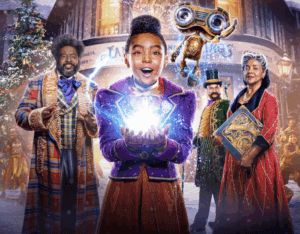
It’s Christmas time and a beautiful, unnamed, dignified, elderly black woman with gorgeous greying locks (played by Phylicia Rashad) sits her young granddaughter and grandson down in front of a roaring fire and reads from an intricate and unique, pop-up, antique book with moving parts like gears. But the film does not revolve around her and her grandchildren, but the characters in the book, mainly the young Jeronicus Jangle (Justin Cornwell) a famed black inventor, his wife Joanne (Sharon Rose), and his young daughter Jessica (Diaana Babnicova).
While the cinematic landscape has long been dominated with snow white narratives of Christmas (both in theme and in casting), David E. Talbert’s Jingle Jangle: A Christmas Journey (2020) arrives not just as a breath of fresh air, but as a vibrant, visually ecstatic celebration of black imagination, intelligence, and joy. It is a sumptuous, high-budget, fantastical holiday musical that follows a multi-generational family across the epic trials of love, loss, and redemption.
Most of the narrative follows an older Jeronicus Jangle (Forest Whitaker), a brilliant, but broken-hearted entrepreneurial inventor and toymaker in the fictitious racially diverse, Victorian-era town of Cobbleton. Jeronicus suffers a double gut-punch. First, he is betrayed by his impatient (for fame and fortune) young apprentice Gustafson (Miles Barrow) who steals the detailed notations of his inventions and his fantastic, miniature, talking male matador doll Don Juan Diego (Ricky Martin) and launches his own competing business. But as if that wasn’t traumatic enough, Jeronicus then suffers the death of his beloved wife. The combined weight of these two events strips him of his zest for life and his passion for invention and a broken Jeronicus sends his equally brilliant and precious daughter away and retreats into an unfulfilling life as a pawnshop broker, shunning all loving connections and forsaking his gift of invention. But when his exceptionally bright granddaughter, Journey (Madalen Mills), arrives on his doorstep years later, she represents an opportunity for Jeronicus to be restored in heart, faith, and imagination.
Although a familiar, feel-good Christmas, family-based, morality tale, Jingle Jangle defies stale aesthetics. The film operates within a beautiful, deliberately Afrofuturist universe, where Victorian charm meets vibrant color palettes, sophisticated engineering, and a dominantly and joyously black world unburdened by the historical constraints of racism and slavery. Instead, the key character and his female descendants are brilliant entrepreneurs, inventors, and dreamers who are beyond competent; they are creative thought leaders who manifest dreams from a knowledge of magical science that others, like the older Gustafson (the hilarious Keegan-Michael Key), do not command. (Jeronicus and Journey literally write their mathematical equations with their fingers in fiery light in the air.) Powerfully too, these black females, as with the others present in the film, all wear their hair in beautiful, Afrocentric styles that flaunt their natural hair textures and the elastic and sculptural properties of their beautifully coiffed manes.
But Jingle Jangle also innovates through its visual style and the charmingly reimagined landscapes of a Victorian European village. The dance numbers in Jingle Jangle are intoxicating and jubilant, a groundbreaking mixture of high-energy hip-hop, contemporary African dance elements, and classic Broadway showmanship. The choreography of Ashley Wallen is an essential and electric part of the storytelling. The musical numbers are not breaks in the narrative; they are the narrative. Sequences like young Journey’s singing of “Square Root of Possible” are elegantly integrated as a fluid and essential part of the story telling. It’s exhilarating (and a little disconcerting), to watch black people clad in Victorian garb made of African fabrics inhabit their fantastical nineteenth-century world as “normal” citizens, people who are joyous, ambitious, and emotionally complex.
The costumes, designed by the incomparable Michael Wilkinson, are a feast for the eyes blending Victorian silhouettes and African textiles. Dispensing with the typically muted palettes of Victorian London, they shine with rich jewel tones, sumptuous fabrics, bold patterns, and exquisite tailoring making a powerful statement about black luxury and refinement.
As the movie unfolds, we follow Journey as she, Jeronicus’s new black, young apprentice Edison (Kieron L. Dyer), and eventually Journey’s adult mother (Anika Noni Rose) endeavour to restore Jeronicus’s faith in himself, family, and love. But it is not until the end that we find out who the film’s dignified black female narrator truly is. (Hint: her name is in the title.)
Jingle Jangle is an exciting, family-friendly spectacle with powerful messages for young and old, as when Jeronicus imparts to young Journey that she should, “Never be afraid if people can’t see what you see. Only be afraid if you can no longer see it.” Jingle Jangle is an impactful Christmas celebration of black family, black genius, and black creativity and well worth adding to your must-see Christmas film roster.
17. Love Actually (2003)
Richard Curtis’s Love Actually (2003) is not a simple piece of holiday fluff, but a fascinating, and at times deeply unsettling artifact of early 2000s British rom-coms. With stars like Colin Firth (Jamie), Hugh Grant (The Prime Minister), Liam Neeson (Daniel), and Emma Thompson (Karen), the film has cemented its place in the pantheon of Christmas must-see movies. But a closer, more critical examination reveals a narrative steeped in privilege and problematic romantic ideals that warrant serious dissection. The film weaves together ten disparate love stories across a sprawling narrative during the frantic weeks leading up to Christmas in London, UK. Although it often achieved warm, joy-filled moments, it also stumbles into uncomfortable territory.
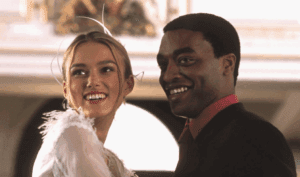
The subtle yet impactful presence of British-Nigerian actor Chiwetel Ejiofor (as Peter) warrants attention. Ejiofor, an actor of immense talent who later commanded the screen in 12 Years a Slave (2013), is regrettably underutilized. As Peter, the groom to Juliet’s bride (Keira Knightley) he is an amiable, handsome black presence in an otherwise starkly white cast. Yet, his role is purely functional: a handsome prop used to facilitate one of the film’s most enduringly popular, yet complex, and by today’s standards, cringe-worthy storylines; the fact that Peter’s best man and best friend the white Mark (Andrew Lincoln), is secretly, and obsessively in love with Juliet. While the film treats Mark’s “crush” as rather harmless, from a critical, contemporary perspective, his actions are less romantic and more stalkerish as displayed in his invasive clandestine filming of Juliet during her wedding ceremony to Peter.
This narrative arc normalizes boundary-crossing behaviour under the umbrella of “grand romantic gestures” and dismisses Mark’s betrayal of both Peter and Juliet as harmless. What’s more, Juliette’s bid to placate Mark with a kiss meant to soothe his unrequited love, also works to sideline and marginalize her black groom who is not allowed to be the hero in his own love story.
Love Actually, is a complex film that entails heartwarming, genuine moments of connection that satisfy a desire for a “feel-good” Christmas movie. Yet, in the narrative of Juliet, Peter, and Mark, its treatment of Mark’s obsessive actions as “sweet,” and the sidelining of Peter from the role of hero in his own love story, fall far short of a truly romantic or loving outcome. Still, like White Christmas (1954) in the 1950s, Love Actually stands as a remarkable time capsule of the positive strides and huge blind spots of early twenty-first-century mainstream cinema.
16. Rudolph the Red-Nosed Reindeer (1964)
The stop-motion classic Rudolph the Red-Nosed Reindeer (1964) is a fixture of holiday programming, beloved for its charming animation and catchy songs. Yet, beneath its warm and fuzzy veneer lies a story brimming with social commentary about conformity, ableism, bullying, peer pressure, and the problematic nature of authority. The story introduces a young Rudolph who is struggling to reconcile his unique appearance (he has a glowing red nose after all) with that of his peers. The plot immediately leads us into a situation where a character is being harmed not because of anything they do, but because of misperceptions of who they are, based on their looks. This initial premise serves as a stark critique of societies that ostracize and bully those who do not fit a specific, arbitrary mould.
The film also critiques how adult authority figures mishandle the situation. In a move that suppresses his son’s individuality, Rudolph’s father, Donner, makes him hide his nose by covering it with mud, forcing him to try to “fit in”. Even Santa Claus is initially dismissive and unsupportive of the young Rudolph.
But the special uses these examples to impart a valuable lesson to children about the power of non-conformity. However, since Rudolph is only widely accepted when his red-nose becomes useful to the dominant group (to light Santa’s path during a low-visibility Christmas night), the message is complicated by the implication that acceptance is conditional.
Perhaps the most intriguing aspect of the movie occurs when Rudolph runs away to the “Island of Misfit Toys” which serves as a poignant, if slightly melancholy, reminder of those who are too often forgotten by society. It is a place for those who have been discarded due to their difference. But their eventual rescue by Rudolph and his friends demonstrates that strength can be drawn from resilience and collective action.

15. A Madea Christmas (2013)
We’ve been through a lot with Madea, including family reunions, funerals, witness protection, Hallowe’en, and even a destination wedding. So, it’s not surprising that Tyler Perry has also treated us to Christmas with his big, brash, wise, hilarious, cross-dressed alter-ego. Like the franchise itself, A Madea Christmas (2013) is an entertainment experience that defies conventional cinematic expectations, operating instead within its own unique universe of broad comedy, melodrama, and unapologetic Christian messaging. Bypassing critical accolades from the white establishment, the film instead caters to a specific demographic that understands and appreciates its specific African American cultural shorthand.
The narrative follows Madea (Tyler Perry) as she is persuaded to visit her niece, Lacey (Tika Sumpter), a schoolteacher in the fictional, oddly named, backwoods town of “Bucktussle,” Alabama. The narrative tension stems from Lacey’s secret cross-racial marriage to a white man named Conner (Chad Michael Murray), which she has hidden from her traditional mother, Eileen (Anna Maria Horsford). While certainly a comedy, the film also provides commentary on serious and sensitive issues like racism, materialism, and complex community dynamics, all while advocating for the true meaning of Christmas. As usual, Perry’s Madea is a vessel of blunt and at time unwanted truth telling and “tough love,” absent polite niceties.
The film’s humour also relies on the clash of cultures and races which ensues between Madea, Elieen, and their black, urban family and the rural, predominantly white, community, best embodied in Buddy (Larry the Cable Guy). The conflict of these distinct comedic personae is a fascinating study in regionally- and racially-specific humour, which produces both innovative and overdone gags.
As with Perry’s other such film, A Madea Christmas centres the black American experience to tackle serious issues about love, family, and forgiveness with humour. However, the film will bring the most Christmas joy to loyal Madea fans who appreciate Perry’s quick-witted, irreverent, observational humour.

14. How the Grinch Stole Christmas! (1966)
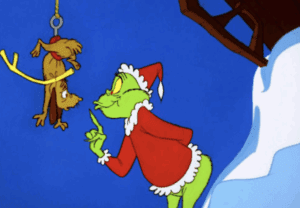
As Christmas baddies go, it may be a toss up between Charles Dickens’ Ebenezer Scrooge and Dr. Seuss’s Grinch. In a media landscape full of bad children’s Christmas fare, How the Grinch Stole Christmas! (1966) still endures as one of the most compelling and aesthetically innovative contributions of the holiday season. Produced by the legendary Chuck Jones and narrated with an impeccably “proper British” cadence by Boris Karloff, this television special expertly navigates the divide between heartwarming sentimentality and an insightful critique of holiday consumerism. The original musical scores, including classics like “You’re a Mean One, Mr. Grinch” performed by Thurl Ravenscroft, were perfectly attuned to the tone and aesthetics of the cartoon.
Based on Dr. Seuss’s popular 1957 children’s book, the narrative follows the Grinch, a furry green, pot-bellied, humanoid creature, who nurtures a profound hatred for the glossy, spectacular, materialistic Christmas celebrations of the nearby Whos is Whoville. With the help of his faithful but abused dog, Max, The Grinch resolves to teach the Whos a lessen by “stealing Christmas” – symbolized by his theft of their presents while dressed as Santa Claus – under the cover of night. However, to his profound chagrin, the Grinch soon learns the true meaning of Christmas when the Whos, undeterred, continue with their festive holiday carolling and celebrations as normal, unphased by his theft.
13. Elf (2003)
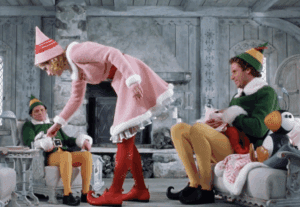
If you’re looking for a whimsical, quirky comedy that’s somehow both sophisticated and slapstick, Elf (2003) is the film for you. Elf is the story of Buddy (Will Farrell), a normal-sized human who was raised by elves – particularly Bob Newhart’s Papa Elf who is the “straight man” to Ferrell’s “funny man” – in the North Pole alongside Edward Asner’s Santa. The film follows Buddy in his quest to reunite with his biological father, the cold-hearted businessman Walter Hobbs (James Caan) in New York City; a trip which serves to highlight Buddy’s absurd differences from “normal” humans through his man-child behaviours like eating maple syrup and candy-covered spaghetti for breakfast.
New York City is the perfect backdrop for the film to explore how Buddy’s rather odd upbringing has ill-prepared him for a life amongst non-elves, people who often appear as mean-spirited, jaded, or downright fearful of expressions of joy, kindness, and love, meaning the true spirit of Christmas. But it is in the Big Apple that Buddy also meets and falls in love with Jovie (a blonde Zooey Deschanel), the shy and reticent Gimbels department store clerk who works as an elf at the Christmas display. In the end, it is Jovie, Buddy’s stepmother Emily (Mary Steenburgen), and his half-brother Michael (Daniel Tay) who assist Buddy in saving the day for Santa alongside a chorus (literally) of New Yorkers who must sing Santa Claus is Coming to Town in unison to attain lift off of Santa’s sleigh.
12. This Christmas (2007)
Few holiday films capture the complex, sometimes chaotic, yet ultimately beautiful reality of African American family life quite like Preston A. Whitmore II’s This Christmas (2007). The film reflects the generational experiences, unspoken histories, strong bonds, and resilience that characterize contemporary black family life.
The movie is framed by the gathering of the scattered Whitfield family for Christmas in Los Angeles, at the home of matriarch, Ma’Dere (Loretta Devine). The film succeeds by presenting authentic, complex, well-developed characters each facing life’s challenges in their own flawed ways.
For example, Quentin Whitfield (Idris Elba) is the son who returns after a five-year absence, with a sense of grievance and criminal obligations to certain dangerous underworld individuals. Lisa Moore (Regina King) is the sister navigating a difficult marriage, while maintaining an outward appearance of stability. Meanwhile, Joseph Black (Delroy Lindo) is the stable, respectable, long-time boyfriend of Ma’Dere, and although a provider and protector for her and her children (in the face of their biological father’s desertion of the family), he is greeted with juvenile hostility from Quentin who resents him for taking his absent father’s place.
This Christmas blends comedy and drama while revealing the ups and downs of a loving but dysfunctional black family gathered for the holidays. It is an exploration of hidden truths, challenges, and the enduring power of forgiveness that transcends the holiday season.

11. White Christmas (1954)
If you’re in the mood for a glamorous old Hollywood Christmas musical, Michael Curtiz’s 1954 White Christmas is a great pick. This Technicolor holiday spectacle is not merely a musical comedy, it is a display of mid-century American elegance, complete with elaborate choreography, beautiful costumes, and refined musical numbers.
The film operates within a world of impeccable tailoring, lush soundstages, and the orchestral musicality that defined that era of old Hollywood. The plot follows two charismatic singing-and-dancing army buddies – Bob Wallace (Bing Crosby) and Phil Davis (Danny Kaye) – as they team up with the sister act of Betty (Rosemary Clooney) and Judy Haynes (Vera-Ellen), to save the failing Vermont inn of Wallace and Davis’s former military leader, Major General Thoms F. Waverly (Dean Jagger). To do so, they must bring their polished Hollywood musical acts to Vermont and combine them to rejuvenate Waverly’s dying enterprise. In between spectacular song and dance numbers, the movie delivers the romance, with, you guessed it, Bob falling for Betty and Phil for Judy.
The highlight of the film remains the sumptuous finale performed on a flawless, snow-covered backdrop for the iconic titular song. However, the dominant whiteness of the movie was not merely in its backdrops, soundtrack, or the nature of its choreography, but in the cast itself. Despite the indisputable talents of contemporaneous black American acting, dancing, and musical super stars like Louis Armstrong, Cab Calloway, Duke Ellington, Ella Fitzgerald, Lena Horne, Ethel Water’s, and the Nicholas Brothers (Fayard and Harold), the film’s cast was exclusively white and included an homage to a popular minstrel song, Mandy (although not performed in blackface). All told, White Christmas is an elegant and enduring holiday film which captures the artistic triumphs and racial flaws of 1950s America.

10. The Fat Albert Christmas Special (1977)
In the crowded landscape of children’s cartoon holiday programming, the animated feature The Fat Albert Christmas Special (1977) remains a visually appealing and morally profound piece of television. While the aesthetic is firmly rooted in 1970s Saturday morning nostalgia, the film transcends its humble origins to offer sophisticated ethical lessons that address themes of poverty, desperation, and genuine compassion with stark sincerity.
The setting is not the polished suburbia of Charlie Brown’s world, but a barebones, often rundown urban landscape. Interestingly though, both settings are largely bereft of adult presence. The gritty and impoverished material world of the characters grounds a plot that centres a family’s experience of homelessness. As much for adults as for children, the writing challenged viewers by avoiding sentimentality, instead presenting complex moral dilemmas like theft not due to the desire for pleasure or luxury, but to alleviate hunger.
Much like Charlie Brown’s world, at the heart of the story is this eclectic group of children who are bonded through culture, race, circumstance, and friendship and who support and guide each other through life’s challenges. Also, like Charlie Brown (1965), The Fat Albert Christmas Special (1977) serves as a vital reminder that the true meaning of Christmas has nothing to do with commercialism, but with love, human connection, and community.

9. Die Hard (1988)
In the vast landscape of Hollywood action cinema, few films manage the seamless blend of pulse-pounding thrills and profound cultural resonance quite like John McTiernan’s Die Hard (1988) Yet, what at first glance is a simple action movie, upon closer inspection was arguably a thrill-packed departure on the Christmas movie.
Where other action films failed to provide interesting or convincing plots, Die Hard brought a sophisticated layered narrative with a charming, somewhat reckless, and defiant John McClane (Bruce Willis). The movie is fundamentally about a man (New York City cop John McClane) attempting familial reconciliation with his estranged wife, Holly (Bonnie Bedelia), during her corporate Christmas Eve party in a Los Angeles skyscraper, the perfect setting for a terrorist attack led by Hans Gruber (Alan Rickman).
The film’s intersection with Christmas allows for a scathing criticism of corporate excess as well as a heartfelt affirmation of love, devotion, and family values. The terrorist crimes unfold under the cover of a festive office party, turning a symbol of corporate gaiety into a stage for their nefarious deeds.

8. The Holiday (2006)
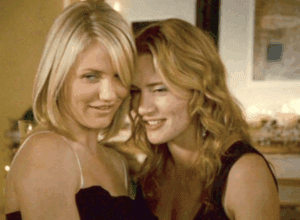
What happens when two unlucky in love, professional, thirty-something-year-old women do a transatlantic house swap for the holidays? Nancy Meyers’s The Holiday (2006) that’s what! The movie has an old Hollywood feel presenting a highly polished, visually sumptuous, and unabashedly aspirational take on the romantic comedy genre. Bracketed by the quaint appeal of a snow-laden country cottage in England and the luxury of a sprawling house in LA, Iris (Kate Winslet) and Amanda (Cameron Diaz) trade homes and experiences during the Christmas Holiday Season in a bid to escape toxic men – Jasper (Rufus Sewell) in Iris’s case and Ethan (Edward Burns) in Amanda’s – who belittle, humiliate, and generally neglect them. Interestingly, their house swap, being orchestrated totally online, means that Iris and Amanda do not initially meet and the two halves of the film play out in parallel at different sites on opposite sides of the Atlantic.
When Iris heads to LA and Amanda to England, it is as if we, the audience, accompany them on their vacations designed to free them from the toxic circumstances (and men) that have imprisoned them. Interestingly, while Winslet’s Iris is far too weepy and lacking in backbone, Diaz’s Amanda is short on emotional vulnerability, as we witness in her inability to cry. The film also brings the romance with Iris finding joy in her ability to support and cheer on the aging Hollywood luminary Arthur (Eli Wallach ) and romance with the Hollywood songwriter Miles (Jack Black), and Amanda finding the passion, family, and love she had been missing with Iris’s brother, the widower and single father Graham (Jude Law) and his two young daughters, Sophie (Miffy Englefield) and Olivia (Emma Pritchard). If you’re looking for a modern, sentimental Christmas rom-com with heart, The Holiday is a great choice.
7. A Charlie Brown Christmas (1965)
In the bustling, often hyper-commercialized landscape of holiday entertainment, A Charlie Brown Christmas (1965) stands as a quiet masterpiece of American television. Charles M. Schulz’s hand drawn, animated special directed by Bill Melendez, is a subtle yet sophisticated popular culture offering that transcended its medium to become a profound philosophical statement on the true meaning of the season. The aesthetic is minimalist and deliberate highlighting the words, actions, song, and dance of the loveable misfit Charlie Brown and his band of oddball friends. Vince Guaraldi’s iconic jazz score provides the film with a cool, refined, and contemplative backdrop. The simplicity and starkness of the 60s animation, avoids the now typical messiness and lack of subtlety of contemporary children’s programming.
The unique brilliance of this cartoon lies in its protagonist, Charlie Brown, who becomes the audience’s pathway into a world weighed down by commercialism. Indeed, Charlie Brown’s palpable despair and existential angst was and still is surprisingly mature for a half-hour children’s cartoon. Bothered by the shallow priorities of his friends and the consumer-inspired greed that has infected the holidays, Charlie instead focuses on rescuing what to his friends appears, initially at least, to be an unsalvageable Christmas tree and organizing a Christmas pageant.
The film’s climax — Charlie Brown’s desperate plea for meaning and Linus’s moving recitation from the Gospel of Luke — recentres the true meaning of Christmas. The subsequent decoration of Charlie’s overlooked little tree by the gang stands as a sign that Charlie’s plea has not fallen on deaf ears. A Charlie Brown Christmas is an enduring Christmas message in the form of a children’s cartoon. It serves as a potent reminder that meaning is often found in simplicity, and that true holiday spirit is about genuine connection and faith.

6. A Christmas Story (1983)
Bob Clark’s classic, A Christmas Story (1983), is another of our can’t miss, cherished holiday rituals. This film is about a little boy’s desire for a longed-for Christmas toy. Although made in the 80s it is set in the 50s, a time when white mothers forced their children to eat all of their vegetables and washed their mouths out with a bar of soap for swearing. Its enduring appeal lies not in festive elegance, but in its meticulous capturing of a rather chaotic working-class American family home where the two-parent white Parker family adhere for the most part to rather strict gender roles that revolve around simple pleasures and the care of their two young sons, Ralphie (Peter Billingsley) and Randy (Ian Petrella). One of those simple pleasures is Mr. Parker’s (Darren McGavin) sexy “award,” a lamp in the shape of a woman’s fishnet stocking covered leg which he insists on displaying in the family’s front room window, to Mrs. Parker’s (Melinda Dillon) horror.
The film is told through the eyes of the principal character, the nine-year old Ralphie, who has a vivid imagination which leads to several daydream sequences. Ahead of its time, the film is also a critical and comical commentary on the dangers of the Christmas season becoming a consumer bonanza where hapless families are lured to department stores to stand in lines to see a tired store Santa Claus and attempt to fulfill their children’s unrealistic expectations about gifts. Much of the film revolves around Ralphie’s bid to convince Santa, and his beleaguered mother, that he should receive a Red Ryder Carbine Action 200-shot range model air rifle for Christmas. The request is met with dismay by this mother whose mantra becomes a warming that Ralphie will “shoot his eye out.”
Alongside the plot of Raphie’s Christmas gift quest is a parallel plot about the dangers of American (and Canadian schools) as spaces of bullying. Indeed, Ralphie is terrorized for much of the film in his walks to or from school, by the school yard bully Scut Farkus (Zack Ward) and his no-good mate Grover Dill (Yano Anaya) who randomly beat on Ralphie as a source of entertainment. But karma comes for Grover when Ralphie, at the end of his rope, fights back, pummelling the larger Grover into submission and taking back his sense of self and safety.
Ultimately, this film is a testament to the power of resilience and a tribute to the memory of a messy, imperfect family Christmas. It is a robust, albeit unpolished, gem that endures because it acknowledges the inherent awkwardness and minor tragedies that make the holiday season so uniquely human.

5. Home Alone (1990)
Chris Columbus’s classic, Home Alone (1990) endures not merely as a family-friendly holiday comedy, but as a surprisingly sharp exploration of family dynamics, suburban life, and the unexpected sophistication of the American child. It is a film that transforms the familiar setting of an affluent Chicago North Shore residence into a tactical battlefield. Young Macaulay Culkin, as the inadvertently abandoned Kevin McCallister, provides a performance that is both charming and strategically astute. He is the unintended master of his domain, forced to protect his household from the inept yet persistent intrusion of the “Wet Bandits” (Joe Pesci and Daniel Stern).
The film’s tension operates on the premise of a domestic siege and on the grievous error of a overworked Kate (Catherine O’Hara), the mother who unfairly shoulders the brunt of the blame and guilt for forgetting her eight-year-old son at home, an ocean away. The true genius of Home Alone lies in its meticulous craftsmanship of chaos.
The McCallister home is the stage for a series of booby traps and deceptions that allow Kevin to stave off the bandits, at least for a while. The narrative uses slapstick violence (think blow torches to the head, thumb tacks to the feet, and a tarantulas on the face) that turns common household items into sophisticated instruments of defence and assault. Endearing too is Kevin’s bonding with this elderly neighbour Marley (Roberts Blossom) – a man he’s been erroneously led to fear – who he advises to be brave and reach out to an estranged son, daughter-in-law, and granddaughter.

4. National Lampoon’s Christmas Vacation (1989)
In our homes, it isn’t Christmas until we’ve watched Clark Griswold (Chevy Chase) try in vain to turn on his over-the-top exterior house Christmas lights. In the landscape of holiday cinema, few films capture the manic, chaotic energy of the season quite like Jeremiah S. Chechik’s classic, National Lampoon’s Christmas Vacation (1989). Chevy Chase, as Clark W. Griswold, delivers arguably his finest performance in this role: a man whose pursuit of an idealized, Norman Rockwell-esque celebration drives him to the brink of insanity.
Griswold is the lens through which we view the absurdity of modern festive expectations. His dedication to elaborate “exterior illumination,” a behemoth of a Christmas tree, and the mandatory presence of extended family, speaks to a uniquely North American earnestness that is both endearing and utterly doomed to fail. Clark’s beleaguered wife Ellen is driven to vices like smoking by a house bursting at the seams with eccentric family members including Bethany (Mae Questel) who says the pledge of allegiance at the Christmas dinner table instead of a blessing and cousin Eddie (Randy Quaid) who arrives uninvited with wife Catherine (Miriam Flynn) and children Ruby Sue (Ellen Latzen) and Rocky (Cody Burger) in tow, the latter with a lip fungus. Oh, and why not let their dog snot run wild in the Griswald home too! (The scene where snot chases the renegade squirrel who has hitched a ride from the Christmas tree farm, through the house, is a hilarious nightmare.)
But Clark’s quest, like his hope for a large Christmas bonus, is not for himself, but to please his family and he intends to take said bonus and put in an inground pool when the summer arrives. So, it is understandable when the arrival of a “jelly of the month” club certificate instead of his usual monetary bonus sends Clark into a hysterical expletive and threat-laced rant which inspires Eddie to kidnap Clark’s boss Frank Shirley (Brian Doyle-Murray) as revenge.
This movie also pleases with appearances by a young Juliette Lewis as an angst-ridden teenager Audrey Griswold and Johnny Galecki as her little brother, Rusty. Julia Louis-Dreyfus also shines as the Griswold’s disdainful and chic neighbour Margo who, alongside obnoxious partner Todd (Nicholas Guest) are tortured by the mishaps of Clark’s obsessive drive to master the art of Christmas home illumination. Beside enjoying the hilarity of the Griswold’s extended family, this movie never fails to make you feel better about your own family holiday messes, because well, almost nobody’s Christmas goes off the rails like the Griswolds!

3. The Best Man Holiday (2013)
The sequel to the Best Man (1999) reunited the original ensemble, a cast whose collective chemistry had only matured. For the most part, coupled up and happy, these black college friends reunite for a Thanksgiving weekend to remember at pro baller Lance (Morris Chestnut) and devoted wife Mia’s (Monica Calhoun’s) luxurious home. But the sparks fly when Shelby (Melissa de Sousa) flirts with ex Julian (Harold Perrineau), Julian confides in Quentin (Terrence Howard) about a shameful discovery in his wife’s past instead of in his wife Candance (Regina Hall), Harper (Taye Diggs) hides his financial and occupational woes from pregnant wife Robyn (Sanaa Latham), Jordan refuses to surrender to the love of her devoted new white boyfriend Brian (Eddie Cibrian), and Lance struggles to come to terms with Mia’s terminal cancer diagnosis.
While the script centres two parallel narratives of death and birth, it also delivers the joy of watching educated, poised, successful black folks indulge in life’s finer things as they nurture their friendships and marriages. Also powerful is the movie’s representation of black male strength, tenderness, and vulnerability as seen through Harper’s worry over Robyn’s and their baby’s safety in childbirth (it’s implied that they have previously suffered miscarriages) and how the black male friends unite to support Lance in dealing with Mia’s diagnosis. Of note also, the “air band” scene with Lance, Harper, Julian, and Quentin performing New Edition’s Can You Stand the Rain (1988) is as surefire turn-on for straight black women everywhere, Merry Christmas!

2. A Christmas Carol (1951)
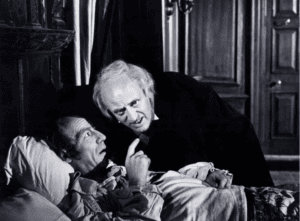
Among the countless adaptations of Charles Dickens’s perennial tale, Brian Desmond Hurst’s 1951 production of A Christmas Carol, anchored by Alastair Sim’s iconic performance as Ebenezer Scrooge, stands as the most vital and artistically complete cinematic interpretation. (Scrooge’s transformation post visit from the chilling ghost of Christmas future is simply breathtaking as he prances around his room singing and stands on his head.) This film has transcended the genre of holiday morality play to become a profound character study of a soul in acute crisis and subsequent rebirth.
The black-and-white cinematography lends a beautifully stark, gothic elegance to Victorian London, perfectly capturing the frigid atmosphere of Scrooge’s world and initial outlook, a world he has reduced solely to commerce and isolation. Bob Cratchit’s (Mervyn Johns) perpetual optimism, sentimentality, and grace make for a stunning encounter, when the predictably miserable Scrooge beats him to work the day after Christmas not to chastise him, but to order him to buy more coal to warm up the office and to inform him about his raise and Scrooge’s intention to help him raise his young family; an act which leads to the restored health of Tiny Tim (Glyn Dearman). The film’s aesthetic is rich without being sentimental, an atmospheric foundation essential for the moral and spiritual transformation that follows.
1. It’s a Wonderful Life (1946)
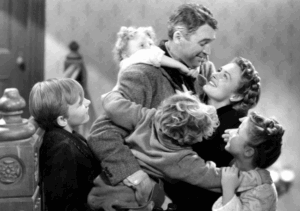
There are a handful of Christmas films that transcend seasonal novelty to achieve what can only be called, cinematic immortality. Frank Capra’s It’s a Wonderful Life (1946) is just such a film. Set in the fictional town of Bedford Fall, this masterpiece stars screen legend Jimmy Stewart as the ever faithful, reliable, and self-sacrificing George Bailey.
George has given up his dreams of travel and college to keep his dad’s Bailey Brothers Building a Loan afloat. Stalked by the ever-miserable Mr. Potter (Lionel Barrymore) who owns everything else in the small town, George takes the blame for drunken Uncle Billy’s (Thomas Mitchell) screwup and is threatened with jail. But when a forlorn George wishes he had never been born, he’s given a remarkable gift from his guardian angel Clarence (Henry Travers), the ability to see not only all the good he had done in his life, but the positive ripple effects of his lifetime of selflessness.
You see, in his youth, George prevented his distraught boss, the pharmacist Mr. Gower (H. B. Warner), from delivering poisonous medication to an ailing child, sparing him from jail and a life as a homeless drunk. He also saved his little brother Harry from drowning when he fell through the ice during a sledding accident, a heroic feat that allowed the adult Harry, soldier, to save an aircraft carrier full of men during the war.
The young Bailey boys are cared for by the black house maid Annie (Lilliam Randolph) who makes the most of a stereotypical role. Married to his dream woman Mary (Donna Reed), and surrounded by their young children, it’s only after George’s life is restored that he finally figures out that he’s the “richest man in town”!