Rebellion, Resistance, and Refuge: Slavery North’s Inaugural Conference Challenges the Revolutionary Archive
A landmark intervention has officially disrupted the historical landscape of New England. From July 9–12, 2026, UMass Amherst became the epicentre of international academic reclamation as Slavery North hosted its inaugural conference: Rebellion, Resistance, and Refuge: Slavery and Border Crossing during the American Revolution.
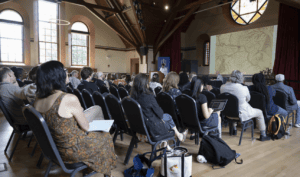
Old Chapel conference venue, UMass Amherst
.
Marking the 250th anniversary of the signing of the Declaration of Independence, this one-of-a-kind academic institute hosted dozens of international speakers, eight panels, and two keynotes. Created with a social justice mandate that centres Art History and the Fine Arts, Slavery North supports fellows researching the often-ignored histories of Canadian Slavery and slavery in the US North.
A Hyper-Productive Force for Justice
Founded in 2023 by our fearless leader, Editor-in-Chief of Black Maple Magazine and Provost Professor of Art History Dr. Charmaine A. Nelson, Slavery North has been a hyper-productive engine. Under Dr. Nelson’s visionary leadership, the institute has already published eighteen open-access, illustrated children’s books, curated three exhibitions, and hosted a relentless calendar of panel discussions, lectures, and book launches.
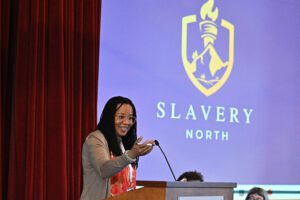
Dr. Charmaine A. Nelson, Provost Professor of Art History and Founding Director of Slavery North at the podium
.
But an international conference of this magnitude is a massive operational feat. Unlike traditional Transatlantic Slavery Studies gatherings dominated by studies of tropical plantation slavery, Dr. Nelson insisted that this conference centre the arts, visual culture, material culture, museum studies, and public history. These disciplines and practices are the tools that most effectively bridge the gap between insular academic circles and the global public.
Unmasking the Archive: Panel Highlights
The papers presented over the four-day gathering aggressively dismantled long-held myths of regional innocence and exposed the harsh realities of the Revolutionary era:
- Exposing Colonial Myths: Colby Gaudet interrogated Acadian myths of innocence by unearthing a chilling early nineteenth-century petition by white Acadian enslavers fighting to secure their legal property rights over black human beings.
- The Strategy of Grief: Scholar and poet Christopher D. Sims spoke eloquently on how enslaved ancestors actively transformed trauma into survival strategies, utilizing song and spirituals to defy the brutality of their status.
- Cruel Abandonment: While many black individuals were forced to accompany White Loyalist enslavers, James Tanzer revealed a darker truth: enslavers frequently abandoned elderly enslaved people to fend for themselves when fleeing to Loyalist spaces of safety.
- Material Control: Exploring the oil paintings of 18th-century Italian artist Agostino Brunias, Grayson Chong illustrated how white enslavers systematically rationed cloth and clothing as a rigid mechanism of physical and social control.
- The Black Maritime Node: Presenters Emily Field and Jamie Huff collaborated to explore black and indigenous military experiences in Bridgewater, Massachusetts, highlighting the complexities of black seamen who took on military service as a direct pathway to manumission, pensions, and citizenship.
- The Black Loyalist Fight:Graham Nickerson—a descendant of the 3,000 formerly enslaved black people evacuated to Nova Scotia and documented in The Book of Negroes—challenged attendees to defend the term “Black Loyalist.” He exposed how newly freed populations were systematically targeted for re-enslavement via predatory indentureship contracts.
- Agitation and Art:Julia Jorati analyzed the multi-layered individual and collective agitation for freedom in Massachusetts including legal case, petitions, and published letters, while Lisa Merrill offered a compelling look at revolutionary popular theatre, proving that many revered expressions of liberty were actually first conceived on eighteenth-century stages by white male actors trying to process the chaos of the war.
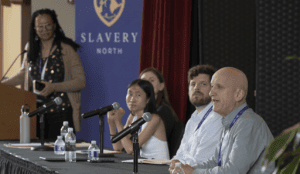
Panel 4: Circulating the Atlantic: Textiles, Tales, and Tars
.
Elite Hospitality and Legendary Care
In alignment with Dr. Nelson’s executive philosophy—never give an attendee a single reason to step off-site—Slavery North’s hospitality was pristine. Between continental breakfasts, curated lunches, and an opening cocktail mixer catered by UMass’s award-winning food services, the atmosphere was deeply welcoming. Dr. Nelson also ensured that local Black-owned businesses, including the beloved Olive Tree Books-n-Voices of Springfield, Massachusetts, were spotlighted with complimentary vendor tables.
.
The entertainment sequence featured an elite performance by the Sean Riddle Jazz Quartet. At the Saturday night conference dinner, guests enjoyed an exquisite multi-course menu, alongside a massive screen broadcasting the England v. Norway FIFA World Cup match—a brilliant nod to the weekend’s energy by a Founding Director who is an elite scholar, a former varsity athlete, and an avid sports fan.
.
Attendees also walked away with a custom, dual-logo (Black Maple Magazine and Slavery North) “swag bag” featuring a limited-edition Black Maple Magazine T-shirt sporting the iconic green, red, and gold paint-stroke maple leaf logo, alongside a custom purple thermal mug, pen, and notebook.
.
By all metrics, the inaugural conference was a spectacular triumph and an unparalleled networking catalyst for scholars working in this vital domain. We look forward to witnessing the brilliant collaborations that emerge from this historic event.