Jackfruit
What is Artocarpus heterophyllus? No, it’s not a newly discovered breed of dinosaur. It is the scientific name for the jackfruit. Jackfruit is a superfood native to south and southeast Asia (particularly the Western Ghats region) where it has been cultivated for over 5,000 years. Currently jackfruit is produced in humid tropical regions such as southeast Asia, the Caribbean, Africa, Australia, South America, Sri Lanka, Vietnam, and Hawaii, and is the national fruit of Bangladesh. Of all these countries, India, Sri Lanka, and Vietnam have the most well-established jackfruit industries.
Fresh jackfruit can be found throughout the regions where it is cultivated and in Asian grocers in Europe, the United States, and Canada. While nothing beats fresh off the tree, luckily for Canadians, jackfruit is also sold in cans and found in some mainstream supermarkets that stock Caribbean and Asian foods. While more and more mainstream supermarkets in Canada and the USA are catching on and stocking fresh jackfruit, relying on these stores is hit and miss.
India introduced the jackfruit to Jamaica in the 1780s and by the mid-1800s, Hawaii, Brazil, and Suriname became familiar with this tasty fruit. Seen as the “poor man’s fruit” in India, it is not consumed by the masses. But attitudes may be changing toward this nutritionally-dense fruit. In 2014, scientists in the University of Agricultural Sciences in Bangalore, India held a conference to discuss how to market and expand the jackfruit industry within India. Furthermore, the United Nation’s 2012 declaration of the Western Ghats region as a World Heritage site has contributed to a growing knowledge and interest in this fruit.
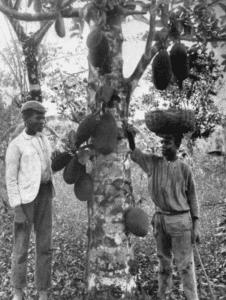
Adolph Duperly and Son, Jackfruit, Jamaica (c. 1905)
The mature, towering jackfruit tree can measure up to 20 metres (70 feet) and the fruit itself, up to 60 cm (approx. 2 feet) long, and weigh from 10 to 100 lbs. Yes, friends, the jackfruit is the largest tree-borne fruit in the world. The tree’s long glossy leaves are good for more than providing shade. The jackfruit’s exterior is bumpy with a green rind and oblong shape that changes to a pale, flat yellow when ripened. The exterior of the fruit is also incredibly ugly (yes, we said it)! It resembles a large, green oblong with a rough dimpled, husk-like, leathery skin. But it is filled with edible yellow, fleshy bulbs attached at a pithy core that runs the length of the jackfruit. The unripe jackfruit has a crisp, firm texture while the ripened fruit has a softer consistency and a strong, sweet, pungent smell. The brown seeds are edible and can be roasted or ground into a versatile, gluten-free, nutrient-dense flour. In Jamaica, it is customary to add jackfruit seeds to rice for flavouring.
The nutrient-dense jackfruit is a cornucopia of vitamins and minerals. It is an excellent source of potassium, iron, calcium, protein, Vitamins A, B, C, and K, riboflavin, magnesium, and copper. The jackfruit bulbs are filled with phytonutrients like beta-carotene which is not only responsible for its rich yellow colour but also for the strong antioxidant properties. The vitamins and minerals support immune system health, promote healthy vision and skin, as well as regulate blood pressure, support heart and bone health, and improve muscle function. Vitamin A helps with maintaining eye health and is essential for the health of the cornea to prevent night blindness and age-related macular degeneration. Like the avocado, the jackfruit contains lutein (and yellow-pigmented carotenoid) and zeaxanthin, which reduce the risk of getting cataracts and other eye disorders. But the range of the jackfruit’s health benefits may extend to fertility. A recent 2024 study by Manveen Kaur Walia et al. evaluating the impact of the jackfruit on testicular dysfunction, concluded that jackfruit extract had a significant beneficial impact on sperm count, motility, vitality, and chromatic integrity.
If all these benefits don’t convince you to give jackfruit a try, let’s talk fibre. The fibre in jackfruit acts as a prebiotic, nourishing the good gut bacteria which improves digestion, nutrient absorption, and supporting a healthy immune system, and microbiome. Fibre-rich jackfruit promotes satiety helping you to feel full longer and lower your caloric intake. Its low calorie/high nutrition content makes it an excellent snack. It aids in the management of cholesterol levels, promoting a healthy heart and minimizing the risk of atherosclerosis. The sweetness of jackfruit can prompt diabetics to shy away from it. But due to its low glycemic index, it can actually help to regulate blood sugar levels; meaning it doesn’t cause blood sugar levels to spike. The fibrous bulb slows down the absorption of sugar into the bloodstream. For the cherry on top, for those of us who crave firm, supple, glowing skin, (and who doesn’t?), the Vitamin C, antioxidants, and water in jackfruit promote collagen production and minimize the damage caused by free radicals which are responsible for skin aging.
To extract the jackfruit bulbs, cut the fruit lengthwise with a knife coated with coconut oil to prevent the sticky white latex sap that is in the rind and pith from adhering to it. Experts recommend wearing gloves. Once the jackfruit is opened, remove the fleshy bulbs and seeds. The versatile jackfruit can easily be incorporated into your diet. It can be enjoyed raw, added to salads and smoothies, and for vegetarians, the less ripened jackfruit can be seasoned, cooked, and used in dishes as a meat replacement. The pureed bulbs are also a key ingredient in jams and ice cream. Custard can be made by boiling the jackfruit bulbs in milk. Make a hearty snack like chips by drying the jackfruit and then frying it in oil. But remember, fresh, ripe jackfruit doesn’t last long, so refrigerate or freeze to use at a later date. The next time you’re at the grocery store, consider picking up some jackfruit-fresh or preserved-and reaping the amazing health benefits.