A Light in the Darkness: 9/11, the Safety of Retreat, and the Radical Compassion of Ganderites
I remember exactly where I was when I heard. Of course, the gravity and unbelievable nature of the horror is what seared the event into my mind, but it was also that I had just moved to a new town as a newly minted PhD to take up a tenure-track assistant professorship at the University of Western Ontario.
That morning, normalcy dissolved. Suddenly, everyone was in the hallways of the multi-floor, concrete industrial open-concept Fine Arts Building. We looked around frantically, seeking verification from each other that what we were hearing was actually true. My mother had called me from the Greater Toronto Area (GTA) telling me that the Empire State Building had fallen down. At the time, the frantic, unfolding nature of the devastation meant that misinformation was spreading rapidly. She had gotten the specific building wrong, but not the devastating details of catastrophic loss.
I remember thinking that what she was saying was physically impossible. Having been to New York City several times, having been blessed to live there for a year in 1997 during my internship eras, and having stood at the top of both the Empire State Building and the World Trade Center to experience those extraordinary, sweeping views, I understood from a first-hand perspective how seemingly impossible it was for such massive buildings to simply fall down. It was only later that afternoon when the static cleared that I discovered that the Twin Towers hadn’t merely collapsed. They had been the target of a deliberate, coordinated terrorist attack.
Growing up in the 1970s and 1980s in the GTA, I had been largely spared the reality of being old enough or news-focused enough to vividly recall any terror attacks on Canadian soil, or lengthy wars that directly involved the Canadian military. I was too young to remember the 1970 October Crisis, during which the Front de Libération du Québec (FLQ) carried out some two hundred bombings and kidnapped and murdered Quebec Labour Minister Pierre Laporte. Oddly, it was not through my school curriculum, but almost entirely through US television documentaries or narrative Hollywood films that I came to learn anything about World War I or World War II, never mind Korea or Vietnam.
When we look back historically, North American histories of European and Euro-American imperialism and colonization were, of course, blood-soaked acts of imperial intrusion—on their face acts of state-sponsored terror and genocide against Indigenous and black populations. But the recent modern histories of Canada and the United States have been defined by their careful maintenance of a perception, if not fully a reality, of social equality, justice, and civic virtues. We pride ourselves on democracies defined by the embrace of multiculturalism and diversity—the cultural mosaic to the north and the melting pot to the south.
But as critical scholars, we would be foolish to turn away from the way that our high standard of living, social refinement, luxuries, and prosperity at home are often bought and paid for by the strategic exploitation and outright violence our governments, militaries, and corporate citizens wreak on other nations. This violence is typically directed at the Global South and other regions we have historically deemed to be our racial, cultural, and social inferiors. I say this not to justify acts of barbarous cruelty, but to remind us that there is a geopolitical reason many people, organizations, and governments in other regions do not consider nations like the USA and Canada to be their friends. For desperate, radicalized people, harming random citizens within the global superpowers that have caused them historical harm seems, to them, a justifiable atrocity.
That day on September 11th, 2001, in the hallway of my new employer, students, staff, and professors alike assembled and looked around at each other asking for more information, for clarity on an attack that we were soon to find out would in some ways never make sense. Airplanes turned into weapons and flown into skyscrapers? Flight students who were not interested in learning how to land? A cockpit seized over Ohio and desperate phone calls made from United Airlines Flight 93 before its passengers revolted, forcing it to crash into an empty field in Shanksville, Pennsylvania? American Airlines Flight 77 bound for Los Angles, instead hijacked and flown into the western face of the Pentagon? Some four hundred and eleven first responders losing their lives as they ran towards danger? What was happening, and how could an act of terror of this asymmetric scale happen “here”? In the aftermath another 9,400 first responders and survivors have since died of related cancers and severe respiratory illnesses.
In the immediate aftermath, I realized instantly that an Islamophobic backlash was certain. After all, within the structures of white supremacy, only white people get to be individuals; the identities of black folks and other people of colour are always stereotyped, weaponized, and made to stand for entire communities, religions, and nations.
In charge of the student gallery in my department at the time, I chose to immediately shatter the comfort zone. I imposed a strict political theme on the mainly white student body who were far too fond of creating apolitical art—a love of “art for art’s sake” which their racial privilege impeded them from recognizing as a direct product of their whiteness. I mounted large-scale, dueling quotes across the gallery walls from our then Prime Minister Jean Chrétien and US President George W. Bush. I asked the students to make art that contemplated not just the human toll of the tragedy, but the geopolitical underpinnings, political stakes, and military fallout of what we were all witnessing. They were not too pleased with me, but I did not care. I could sense in the aftermath the urgent need to engage intelligently and responsibly, something humans are not necessarily good at.
But sometimes, we are.
Some 1,777 kilometers northeast of New York City in Gander, Newfoundland, a small town was preparing to welcome planeloads of international passengers. When the FAA completely shut down US airspace at 9:45 AM, dozens of transatlantic aircraft too far into their flights to turn back had to be diverted immediately. Canada’s Gander International Airport was the first major, safe North American landfall point for wide-body aircraft crossing the Atlantic Ocean. The town safely absorbed thirty-eight flights on a moment’s notice, swelling a community of 10,000 residents with 6,700 stranded, terrified passengers.
Rather than leaving these traumatized, unexpected visitors to languish in a bureaucratic holding zone, one by one, big-hearted locals arrived at hotels, schools, churches, community centers, and legion halls to graciously collect distraught travelers and shepherd them back to their very own homes. Area pharmacies filled critical prescriptions without cost, banks of free public phones were installed for passengers to call their families at no cost, and massive donations of toiletries, food, and clothing flooded in. Generous Newfoundlanders organized town tours, bowling matches, concerts, and plates of regional cuisine to soothe the “plane people.”
Inspired by these staggering stories of cross-cultural generosity, the Canadian husband-and-wife writing team Irene Sankoff and David Hein wrote the book, music, and lyrics to the musical Come From Away after traveling to Gander in 2011 to interview residents on the 10th anniversary. Developed at Toronto’s Sheridan College and enjoying breakout runs in San Diego, Seattle, and Toronto, the musical made its official Broadway debut at the Gerald Schoenfeld Theatre in New York City on March 12, 2017. It ran for a historic, highly profitable 1,669 regular performances before closing in October 2022.
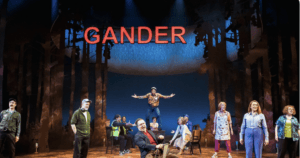
Characterized by an energetic, foot-stomping blend of traditional Newfoundland folk music, Irish/Celtic roots, and contemporary rock influences, the show has been globally praised for its heartwarming depiction of the best of humanity in the worst of times—a permanent musical archive celebrating resilience, kindness, and empathy.
This year, on the 25th anniversary of the tragedy, townsfolk, officials, international dignitaries, and some of the “plane people” (passengers and flight crews alike), gathered in Gander once again. Former Prime Minister Jean Chrétien who had shepherded the federal support effort in 2001 addressed the assembly, speaking of the gravity of the anniversary within the context of the damaged relations and real-time provocations of the U.S. government, which threaten to disrupt generations of deeply intertwined political cooperation, cultural appreciation, and outright affection between Canada and the USA. It was this exact affection that formed the underpinning of the open-hearted response of the Gander residents to come to the aid of the passengers, crews, and indeed the USA in its hour of need.
As Prime Minister Chrétien noted in his powerful address, driving home the true architecture of Canadian strength:
“Never mistake our tolerance for lack of determination. And never, never mistake our kindness for softness. Building a country like this, with this climate and this geography, is a sign of toughness, not of weakness. Welcoming people from all over the world, caring for each other, including the weakest in society, is a sign of strength. We embrace our friends and we help them in their moment of need, but we bow to no one.”
With their instinctive goodness, the people of Gander made a whole nation proud and symbolized the very best of Canada in the worst of times. Let us remember their profound kindness and collective care as we hold those who lost their lives in the intertwined tragedies that unfolded that day in our hearts.